
I screwed up.

I had a little fender bender. Nothing major. I allowed myself to get distracted while waiting for the light to change at an intersection and tapped the car ahead of me. Seriously -a tap. But to the dude driving, it was major. I didn’t have my phone with me so I couldn’t take any pictures.

It was a small spot and smudge on his rear bumper but you would have thought I had rammed him hard. We did the exchange of information and I asked him to text me the photos he took.

I made a report to my insurance, thinking I would just warn them that a claim would be coming from this guy’s insurance. I particularly specified that there was no damage to my car, I was merely sending information.

I did get the photos from the guy and only one photo match what little damage I originally saw. Bad move, not being able to take my own pictures. The ones I received showed more damage than I remembered, included a massive swipe along the bumper.

My insurance asked me to send photos of the damage to my car. Yes there are a few dings and scrapes, but it was a used car, 11 years old. Next thing I know, I’m getting an estimate for repairs to my car. I immediately wrote back and said I’m not claiming and damage. The scratches and whatevers are not new.

I was copied into a message from the estimator to the agent when he forwarded my email to her where I’d stated that I sustained no damage. Basically, “look at what our customer wrote.” I guess people don’t turn down money. However my latest email says payment is on its way.

I realize it doesn’t make any difference to whether my rate will go up or not. Next year I will pay more for my insurance just for making the report. The estimate for the damage they saw in the pictures I sent was $1200 plus. I have a $500 deductible so a check for $700 or so is on its way. Honestly, I should just take the bus, except I can’t always get where I’m going by bus. Story of my life.
 Creating Artist Trading Cards with Dollar Tree Crafter’s Square Items

Way back during the Great Covid Lockdown, I did an online session on making Artist Trading Cards for members of the Bodgery, a maker space here in Madison.

Supplies

From the Dollar Tree

Crafter’s Square:

  • Stencils
  • Stickers
  • Rub-on stickers
  • Tempera Watercolor
  • Rubber stamps

Other supplies

  • Sheet of sturdy paper such as card stock, drawing paper, watercolor paper, or Bristol board sized 8-1/2 by 11 inches.
  • Ruler, craft knife, and cutting mat, or paper trimmer
  • Ink pads
  • Paint brush – about ½ inch (across or in diameter) depending on whether you have a flat or round brush.
  • Scissors
  • Magazine or book pages
  • Glue or glue stick
  • Pencil
  • Fine-tipped black pen
  • Something to use as a palette.
  • Two containers for water
    • One for rinsing brushes
    • One for clean water to dilute paint.
  • Rag or paper towels for wiping brushes.

Optional:

  • Craft heat gun or hair dryer for drying paper.
  • Cosmetic sponge or dauber for distressing edges.
  • Distress ink or tan ink pad for distressing edgesd
  • 12 x 12 single-sided cardstock cut to 7 by 10-1/2 inches.

On the back of the sheet of paper, mark boxes 3-1/2 inches tall by 2-1/2 inch wide. The number of cards will depend on the orientation of your paper. 8-1/2 by 11 will make 9 cards;11 by 8-1/2 will make 8.

Once you mark off the card shapes, turn the paper over. Squeeze a small blob of the three primary colors onto the palette. Dip your brush into the clean water container and then into your first color.

Make random streaks and lines in each color across the paper. Clean brushes after each color to keep them clean. Overlap marks to create additional colors. Let paints dry.

Stamp images randomly across paper to create additional background interest. Cut cards apart and distress edges if desired. Use book pages to select words and phrases to decorate front of cards. Select embellishments from sticker sheet for front of card.

Before gluing items down, test arrangements. Once you are satisfied, glue everything down. To ensure lasting adhesion, apply glue to each sticker and phrase before laying them down. Glue stick adhesive tends to dry out and lift after a while.

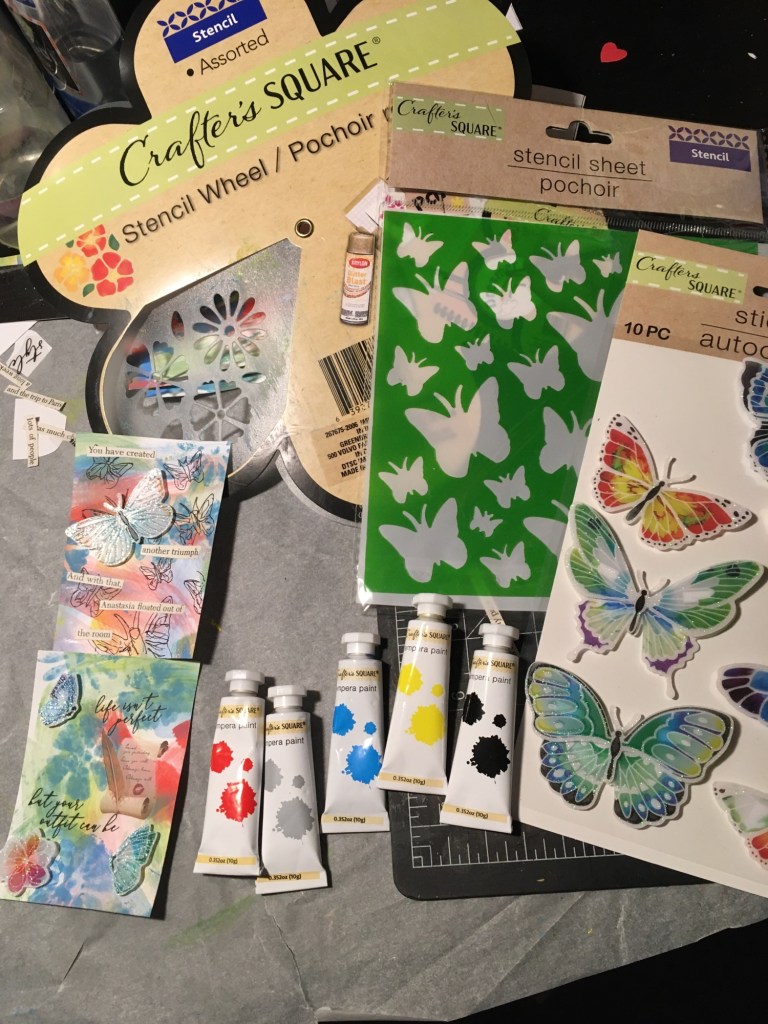
Crafter’s Square art supplies.

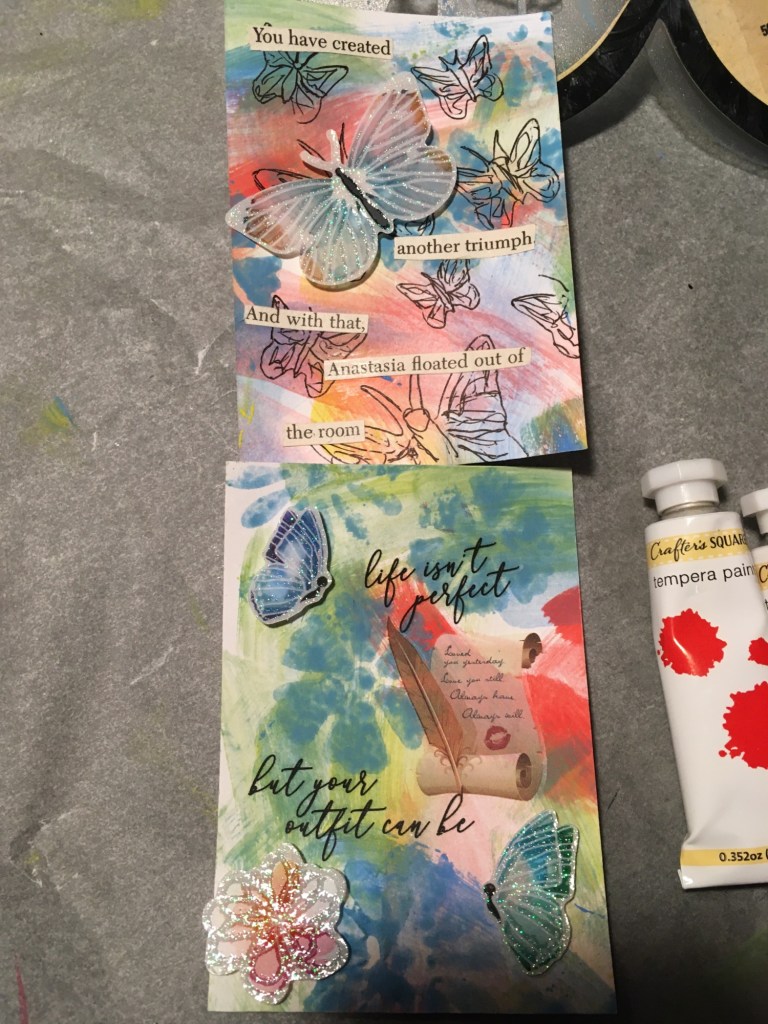
A couple of finished cards.

The items are fairly nice to use and affordable so any one with a couple of dollars can make a small piece of art to share. You don’t need to spend a lot of money on art supplies.

Since the time I did this class, Dollar Tree has added more craft supplies including fabric and vinyl that can be used with die-cutting machines such as Cricut. If there’s a store near you, check them out.

What the heck is with the long absence?

Total depression- the kind that makes you want to just give up. But I didn’t. I got help, but it took a long time. Things are looking up and I’m getting more involved. I’ve spent too much time not doing anything except hiding between book covers. Books aren’t demanding. They don’t ask to borrow money and not pay you back on payday. They don’t call and then proceed to tell how their life is sucky and not ask how I’m doing. They don’t make you feel unloved and useless. And it’s better to read a book than to try to eat the pain away. Been there, didn’t work. Weighed 200 pounds. Not any more.

I’m holding the line here. I have a long way to go. I’ve started by getting my surroundings in order – getting the house presentable, clearing weeds and invasive plants from what used to be my garden. I’ve got a few tomato and pepper plants in pots. Pots of flowers are on the front steps. I’ve mowed a few times. Everything looks good from the street.

I’ve showered more. I’m certain people who encounter me appreciate that. I’ve been eating more fresh stuff instead of frozen pizza. I wore myself out doing a screen printing project for the makerspace I belong to – 120 aprons and 90 tote bags as gifts for our members. Tough work to do alone in a week, but it was a last minute decision and everyone else works during the day.

After all that, I did a “State of the Union” type presentation to the membership. It went well in spite of a few technical difficulties and interruptions. One of our founders doesn’t quite understand that we know who she is and she doesn’t really need to remind us of the fact whenever she is present by interrupting.

I’ve fallen six times in the last month. No injuries to speak of, but a bit concerning. I’m being sent to the Geriatric Fall Clinic. Apparently, I now fall – see what I did here- into the Geriatric category. I didn’t notice. But now when I look, I can see that some old woman managed to swap bodies with me – gave me this wrinkly and painful one. This old body seems to fall down too much. I want my other one back.

That’s probably all the update you can take for now, so I’ll end here. As a friend used to say, “Rest and be kind.”

Making book cloth using iron-on interfacing

I like to have colorful book covers for my handmade books. I have a supply of library quality book cloth, but it is solid-colored, boring, institutional looking, but it’s very sturdy.  I also have some nice Japanese papers that I use to cover book board as well. But sometimes I want a cloth cover, but not a plain one. I found some videos on YouTube that showed a way to make book cloth from regular fabric. The videos I learned from are listed below.

The supplies you will need are:

  • A Fat quarter from the fabric store or a half yard of fabric

A fat quarter, if you don’t know, is a specific cut from a yard of fabric. It is not the same as a quarter yard. When you order a quarter yard, you get a cut of fabric 9 inches in length across the width of the cloth. A fat quarter comes from a yard of fabric cut lengthwise and widthwise to make 4 equal sized pieces of fabric, 18 by 18 inches for 36-inch-wide fabric or 18 by 22 inches for 45-inch-wide fabric. Fat quarters are readily available in fabric and craft stores and in the sewing section of Walmart and similar stores for under $3.00 US.

  • Lightweight fusible interfacing – the double-sided kind. One side will be fused to the fabric and the other to the next item on the list. The interfacing can be found in the fabric by the yard section of the fabric stores and as a 1-yard pre-packaged cut in the crafts area of other stores.
  • White tissue paper. You want white because the dye used for colored tissue tends to bleed if it gets wet.

You will also need:

  • An ironing board
  • A pressing cloth
  • An Iron
  • A cutting mat
  • A ruler or yard stick
  • A rotary cutter or scissors

Wash and dry your fabric to remove any sizing. I usually wash all my fat quarters at one time, iron them, and fold them once and lay them on a clothes hanger for later. Place your fabric on the ironing board with the wrong side up. Iron out the creases and wrinkles using the steam setting. Cut the interfacing slightly larger than the fabric. Lay the interfacing with the paper liner side up. Turn off the steam setting or empty the iron. Press according to the instructions on the interfacing package. Follow the package directions fir when to peel off the backing paper. Peel the backing paper off and cover with the tissue paper. Iron again to attach the tissue paper. When cool, trim the tissue paper edges flush with the fabric using your rotary cutter or scissors. Roll the book cloth into a tube to avoid creases and store until needed. Use like regular book cloth.


Treasure Books

Nik the Booksmith