Thursday, October 9th, I taught basic sewing to a group of high schoolers. This time, instead of stuff sacks or pillow cases, they made can cozies. I was scheduled to teach four or five students, depending on what prior projects weren’t completed, but I made kits for six just in case I got six. I have six sewing machines to use for teaching that were purchased with grant money from the school district.
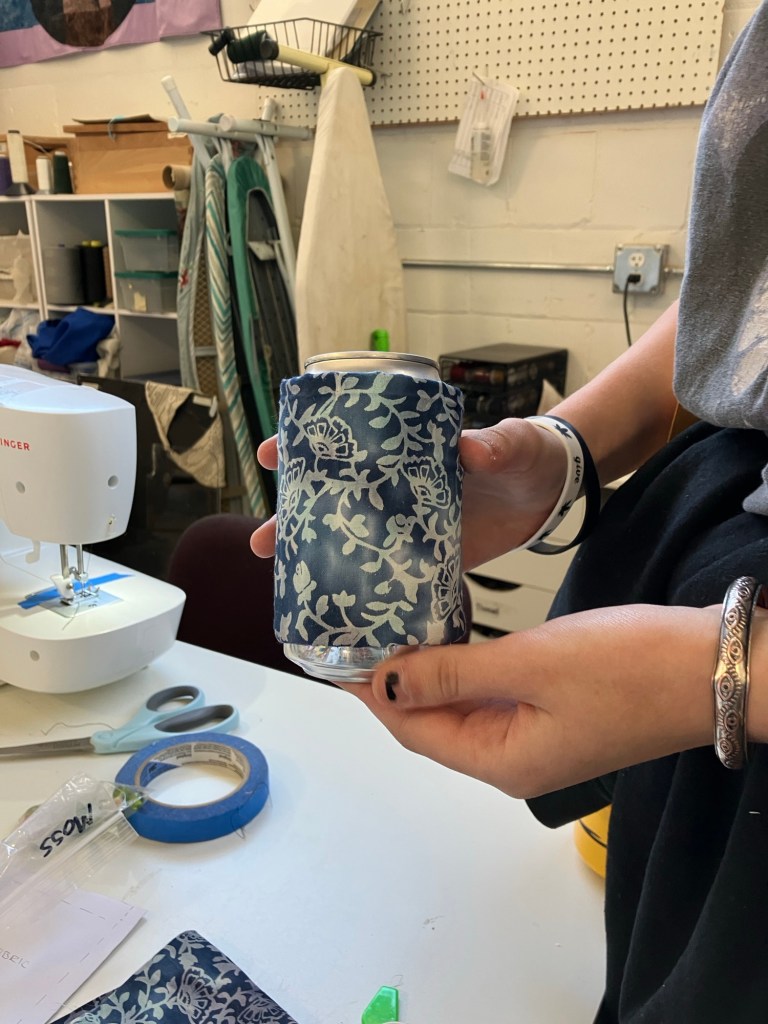
The can cozies were simple- two strips of fabric with batting sandwiched between them with a strip of velcro to hold the sides closed. I have one I made one that has craft foam instead of batting. That seems to work as well, so I’ll use that instead of batting.
Can cozy made by one of the students.
It was fun. My pattern turned out to be a bit short in length so the cozies didn’t turn quite as well-fitting as they should have. For the next class, I’m going to allow larger seam allowances which we can then adjust and trim.
So the boomerang child is once again employed. I hope this works out. If you sense a bit of underwhelm, it’s because he has quite a shaky employment history. The longest he’s held a job is just under two years.
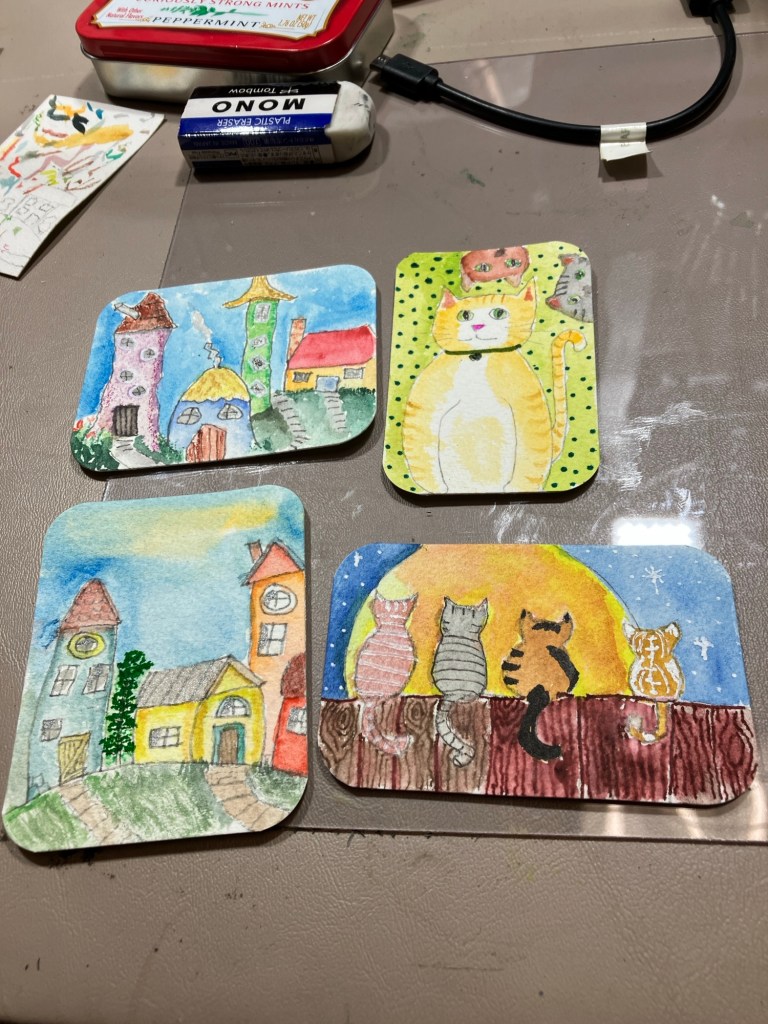
More tiny paintings
I’m still painting. I have three paintings to do and the second book will be filled. That will be 50 out of the 100 paintings completed. I’m also working on some larger pieces— 9 by 12 inches.
My soap making class was cancelled due to a lack of interest. I only have one person registered for my paper making class on Saturday. Maybe my teaching fee is too high. I think I’ll make some feedback forms to find out what members want.
I’ve had some sort of crud for the last week — mostly dizziness. I still seem to have it. I had 2 bookbinding classes Saturday. Attendance was light. I know one person was refunded, but two other people didn’t show up.
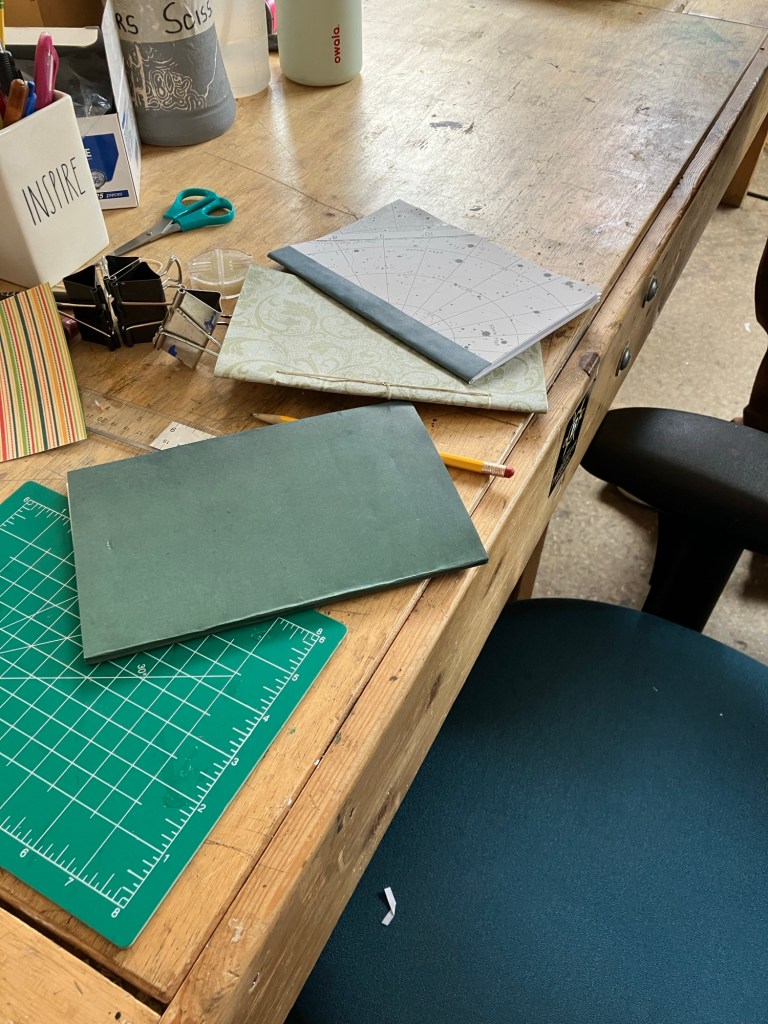
This was my Binding Single Pages class. Only 3 signed up. Another set of single sheet books.
The morning class was Bookbinding 101.2 – Binding Single Sheets. We did three types of bindings. The first was a Perfect Binding. Thats the type of binding you have on a paperback book. It’s a glue binding where PVA glue is brushed on the edges of what becomes the spine.
The three students created their own covers out of cardstock creased in the center to form a spine which was then glued to the text-block. The paper used for all three of the text-blocks was copy paper cut to size. For more advanced classes, I use medium weight sketch paper. I also charge more per student.
The second book was a simple form of the Stab Stitch. Two of the students used two holes and one used three. When I do my class on Japanese binding, we will use more intricate threading patterns and chipboard for sturdier covers.
The third book was a combination of sewing and gluing. It makes more of a scrapbook-type book. The pages were sewn together with a 3-hole stitch and then glue was applied to the thread to secure it. An additional layer of glue was applied to the spine to hold a separate piece of card-stock as a spine. The covers were then applied to the spine piece with glue.
This a great way to keep kids artwork together in a book form. For the covers of that type of book, I would recommend chipboard covers cut to the size of the largest piece of art being bound. The chipboard could be covered with wrapping paper, rather than pieced together card-stock. A coat of Mod-Podge or thinned white glue could be brushed on the covers so they would last longer.
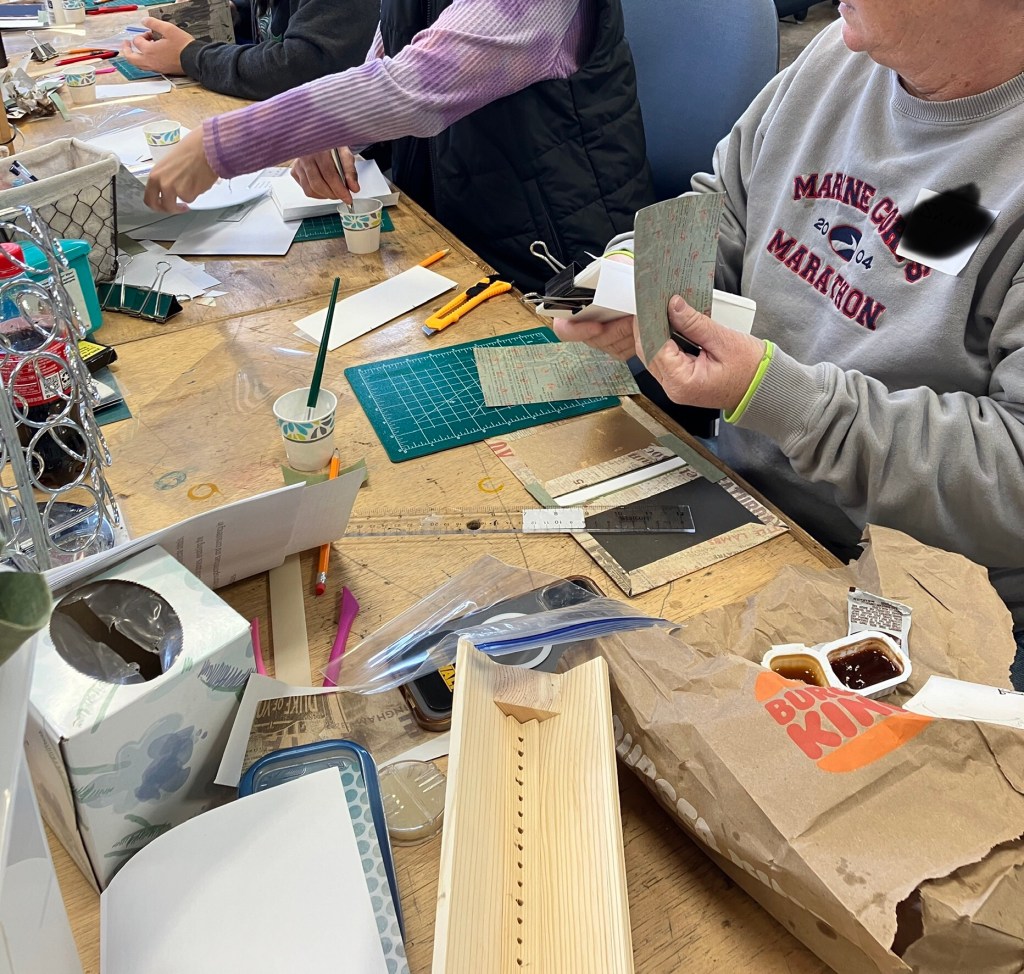
The second class was basic bookbinding where my 4 students learned how make a book with three signatures and how to attach the signatures to a simple spine. I didn’t get pictures because I started feeling off again. All I know is that whatever I have is not Covid. I’m going to have to find out if I have an ear infection since my balance is off.
After everyone left and I had cleaned up,I decided to spend time in my studio. Mistake! I sat down and almost immediately filled my tiny wastebasket with barf. Fortunately there was a plastic bag in there. I sat for awhile and then carefully drove home and went to bed.
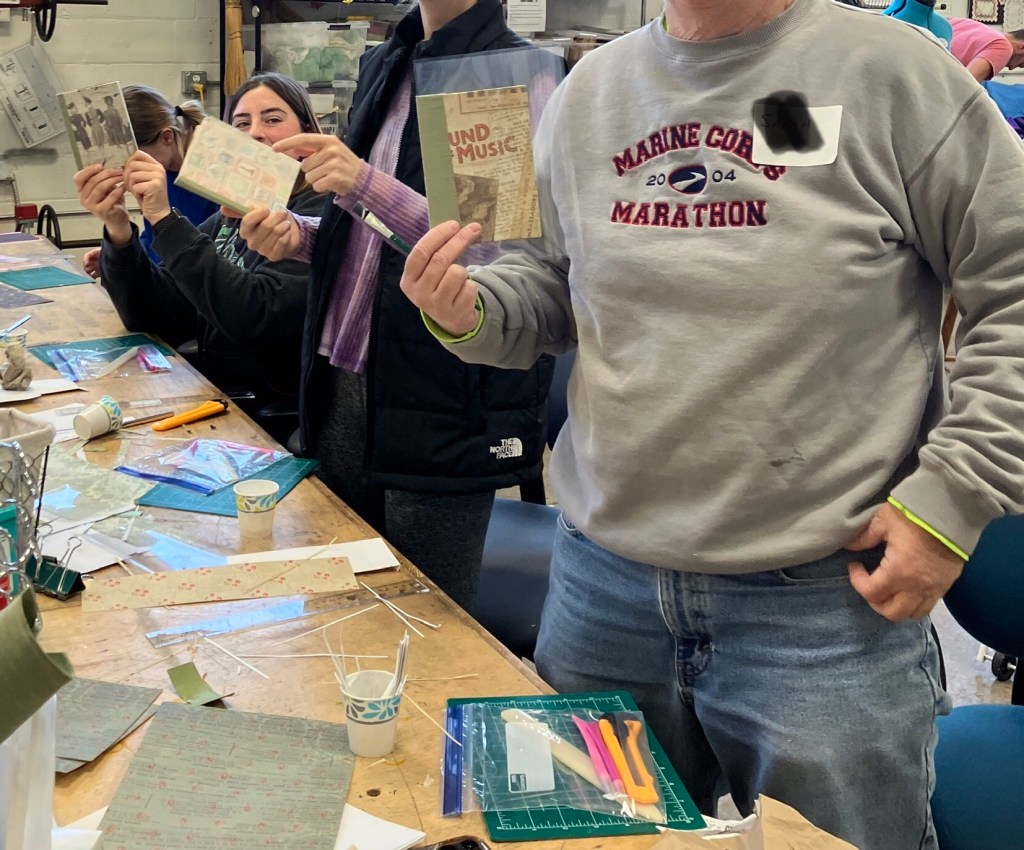
The class went well. Seven students of the eight who paid showed up and were able to go home with 4-signature hard-bound books. The books were small, but they should last for a while.
Finished books.
I provided pre-cut mat board to use as the covers. The boards were covered in scrapbook paper and the spines were book cloth. Sketch paper was used for the signatures and everyone was checked off on the industrial paper cutter in order to trim the signatures to a uniform size to fit in the binding.
The group went home with a kit containing a large-eye needle, a cutting mat, a knife, and a couple of paper piercers. Most of the kit was bought a Dollar Tree so not a lot of money was spent. I spent around $6 per student. I charged them $35 for the class.
I have a basic book binding class coming up on the 19th of this month. The class is fully booked and I have been making up kits for my students. They will learn how to bind a simple multi-signature hard cover book. I’ve added more supplies to my kit so I can teach 8 students at a time. I don’t know if there will be any youngsters in the class, but it would be great if there were. Perhaps in the future, I will offer a “Bookbinding For Kids” class.
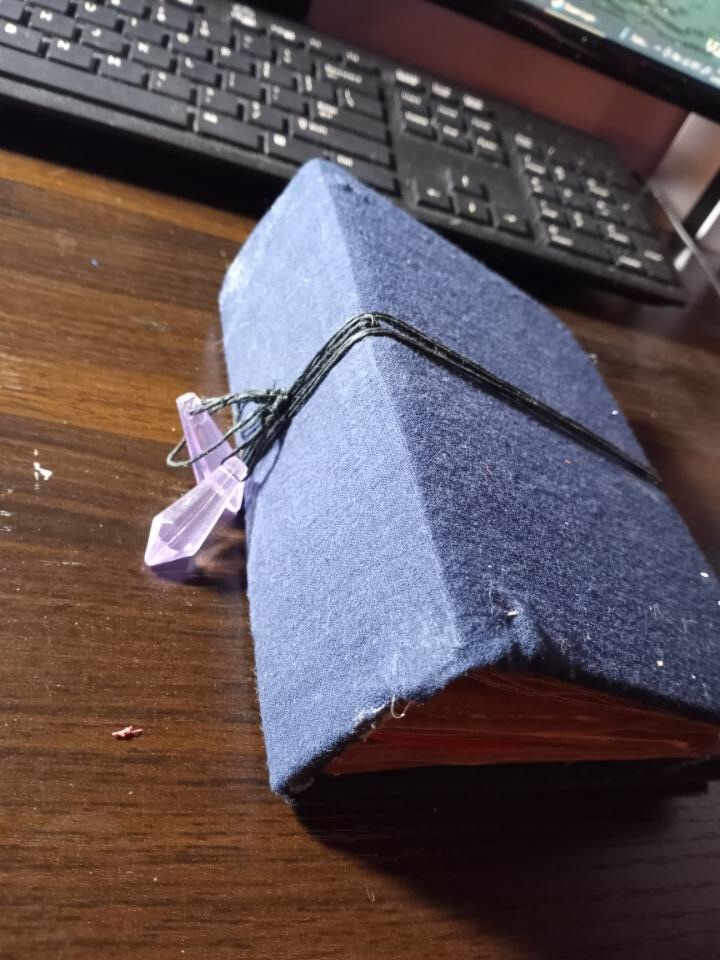
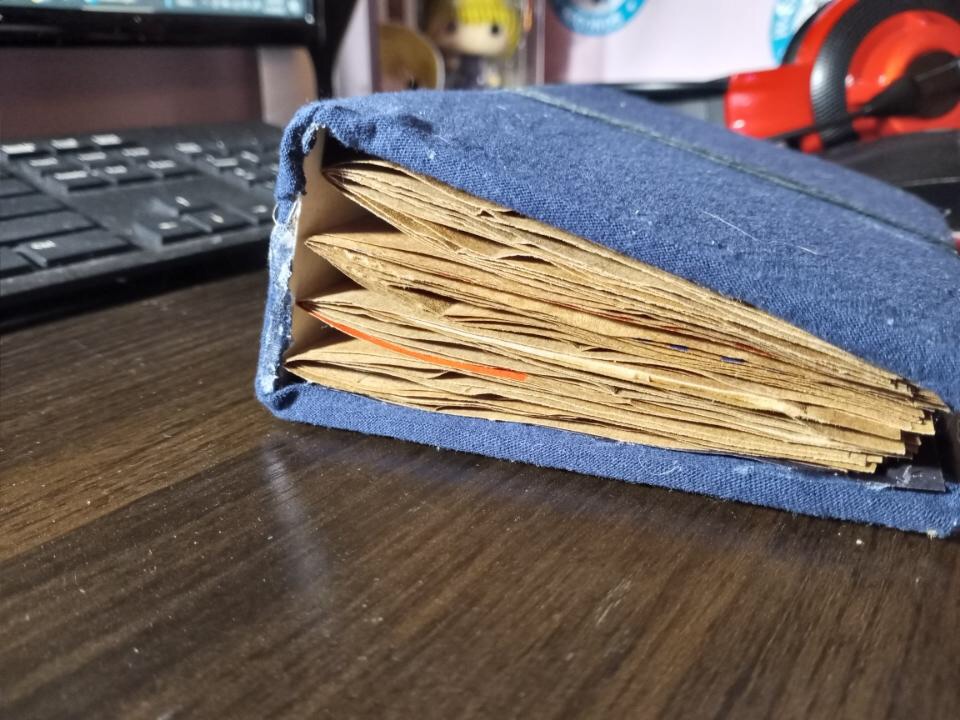
Two views of a book made a few years ago by my youngest granddaughter on her own after a Saturday book making session with Nana.
I’m using sketch paper as the pages. Normally, I use whatever copy paper I have for classes, but it’s flimsy, and while the book is usable, it’s not all that nice. The sketch paper is more durable than copy paper and will hold up better for writing and drawing.
Once they master the basics, I hope they will be inspired to create their own books to use as journals or sketchbooks. For this project, I have cut mat board to 4-1/2 by 5-1/2 in size. I cut the 9 by 12 inch sketch paper in half and they will get the equivalent of six full size papers which they will learn to trim. The maker space currently has an electric industrial paper cutter we can use.
I’m making prototypes to show the various stages of binding from how to determine the grain for folding, covering the boards, and assembling a completed book.
I could have two half-sheets folded as a single signature for six signatures, or up to six half sheets for larger signatures. The problem with larger signatures is a phenomenon called “creep”. When more than two sheets are in a signature, the edges become noticeably uneven, giving a signature a pyramidal edge as each inner paper adds a sliver to the outer edge, with the centermost folded sheets projecting out a distance equal from the edge of the outmost folded sheet like this sideways v >. That gives an uneven edge to the text block.
That’s not a bad thing as many older bound books have signatures arrayed like this. Most book binders trim the edges of the entire text block so they are even before binding the block into the cover. It’s a matter of preference. It’s harder to trim the signatures evenly by hand without an industrial paper cutter that can handle a thick text block.
Depending on the look a binder is trying for, creep could be esthetic. I personally don’t care. Some of the bound item have uneven edges, some are trimmed. I’ve spent a bit on inexpensive binding supplies this round so that I have enough of the basics for each student to take home. They’ll get to keep a bone folder, a couple of piercing tools, a needle, and a good length of waxed thread.
I don’t have waxed linen thread, so we’ll be using waxed cotton tatting thread. I use a beeswax thread conditioner that can be found in the notions area of any fabric shop and run the length of thread across from end to end. I used to use a candle stub before raiding my sewing box for the beeswax.
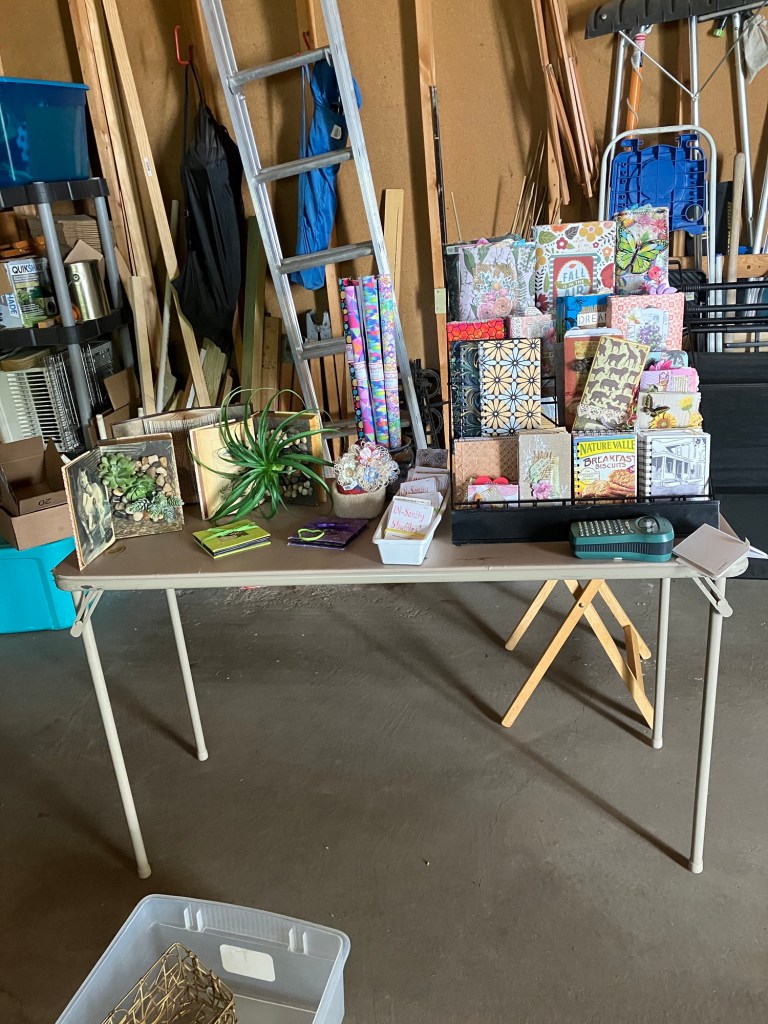
Trying to work out an arrangement of some items to be set up for a sale with only 1 table allowed. Not everything shown here was taken to the sale.
For my junk journals, I’ve used embroidery thread, dental floss, rattan ribbon, perle cotton, and satin ribbon to stitch signatures and attach bindings. The stitching for the junk journal signatures is mostly done on the outside of the spine and can be done very decoratively. I also like perle cotton for doing Japanese Stab Binding. This technique will be a different class offering.
A cloth-bound sketchbook I made for my youngest Granddaughter’s 13th birthday.
I’ve been spending time watching tutorial videos on the Cricut cutting machine. My next class at the maker space is Saturday and I will be teaching several people how to use the Cricut software, Cricut cutting machine, and our heat press to create unique gifts.
I will bring a variety of glass, paper, plastic, and fabric items to show what can be done with various types of vinyl, including heat transfer vinyl with the heat press. I’ve made stencils for etching glass, a design for a bib, plus designs for tee shirts and glass objects such as plates and jars.
I haven’t checked the stash of objects I keep at the maker space lately, but there should be at least one plate, a couple of glass mugs and coffee cups. I din’t think there are any fabric items in the box, but I’ll bring a couple of tee shirts, a fabric tote, and a ballcap to make up.
Also this week, I had some students from a local high school to teach sewing to. I generally have the kids sew pillowcases as they are simple, only have two seams and a hem to sew. It seems to take them most of the two hours to finish their pillowcases.
I bought precut fabric in a variety of patterns and colors from Walmart. That was faster than my first classes where I used fabric we had at the maker space and had to cut to size. My first classes were assorted ages, either children of members or a group of students from the neighborhood.
Next week is the big project – sewing pillow cases for Ryan’s Case for Smiles https://caseforsmiles.org/. There will be up to forty students with their instructors, taking turns cutting, pinning, and ironing fabric as well as sewing the pillowcases for kids with cancer.
We’ll have ten sewing machines going. I’m not certain how many cases we’ll get done next week, but we’ll get as many done as we can. And maybe schedule a second session to finish up. I was asked by a member if I arranged for compensation for my time. I did not. But if they offer, I’ll accept it. At any rate I’ll definitely be filing extra 1099 forms for tax season with the classes I’ve taught so far.
At the end of the month, I’m going to schedule a class on how to read a sewing pattern. There are a few beginning sewers/sewists(?) who have asked me what all the markings mean on sewing patterns. This one will be a free class, but I’ll require sign ups so I’ll know if I need the classroom with the projector.
My third class will be melt and pour soap-making. I’ve been making soap on and off for 17 years. My first bars were cold process castille soap. I started soap making shortly after my youngest grandchild was born. Since the other three live 900 miles away, I was determined to be a part of this child’s life.
One thing I wanted was to make certain she had good soap without additives and strong scents. I’m mostly scent free, except for a few scents such as lavender, cedar and saffron, and mint which I find pleasant enough. When I make soap for others, I tend to use the first two and the mint is used with chocolate to make a chocolate-mint soap.
I do have other scents that I use for cleaning and as all purpose air- freshening. But most of my soaps for my use are unscented or lavender. When I give soaps as gifts, I use other fragrances that most people find pleasant. Those are made in small batches.
Back to my class, hopefully I will have all eight slots filled – there has been a good response so far. The class is going to be held in November at the maker space I belong to. Offering classes is a way we engage other members and teach them new skills.
There are classes offered every week in every area of the shop -woodturning, ceramics, hot glass, and others. All the classes are taught by members skilled in the use of the tools and materials. We are all volunteers and no limit is put on how many classes or what we can charge for our expertise.
I usually just charge small fee for time and materials, while some of the others are actively supplementing their income. At the end of the year, the person who is in charge of posting the classes will send out any tax forms that we need to report our class income. This year, I will probably be at the limit and will get a 1099. No biggie, I always report my sales and income.
I wrote up three new classes for the members of the maker space I belong to. I’ll be offering a class in using our heat press to make unique gifts. This will include training on our Cricut cutting machine for cutting vinyl for stencils and transfers.
Our heat press has attachments for applying vinyl designs to shirts and other flat items, for mugs and tumblers, ball caps and two sizes of plates. We actually had it sitting around disassembled for almost a year until I finally put it together and taught myself how to use it. I’ve given classes in its use before but it doesn’t get much use since we got screen printing set up.
What I plan to show my students is that the combination of the Cricut and heat press can give them more options for unique personalized gifts. I recommend screen printing for runs of multiples of the same t-shirts or fabric goods. We do have several members who use the Cricut or our big vinyl cutter to make stencils for screens, but for a one-off, the two machines work well.
My second class is basic book binding. I’ve been repairing and making books since 9th grade. I had a open period and started working in the library during that time. We would be given discarded books that had missing pages or wrecked bindings. My job was to make a page template and type up the missing pages from a borrowed copy to be bound into the book. This was ages before copy machines were a thing.
I found it much more interesting work than taking what was called Home Economics which was a course for only female students to prepare them for a home and family. Now Home Ec has been repackaged for both female and male students to teach them some life skills, but not nearly enough skills.
I actually have a side business of repairing older books by hand. I’ve restored both leather and cloth bindings and rebind those that need it. I no longer type up missing pages, but I do use acid-free tape to repair torn pages.
My bookbinding class will have the students build a book from making the signatures and cover to assembling the signatures and cover to make a useful notebook. In the interest of time, I will make basic kits containing the papers, and chipboard, decorative papers, and permanent glue sticks. We won’t be making books to last for ages – just something easy and usable.
As in not posting. My paper-making class is about to be cancelled. Only one person signed up. I guess I charged too much. Most classes at the maker-space are from $50 to $250. I charged $50 per person and $25 for kids. I normally only charge a materials fee based on the average amount I pay for supplies plus $5, so people probably think the cost is too high.
As far as I know as of today, only one person has signed up for tomorrow’s session. I’ll ask if they want to attend the August class and postpone this session.
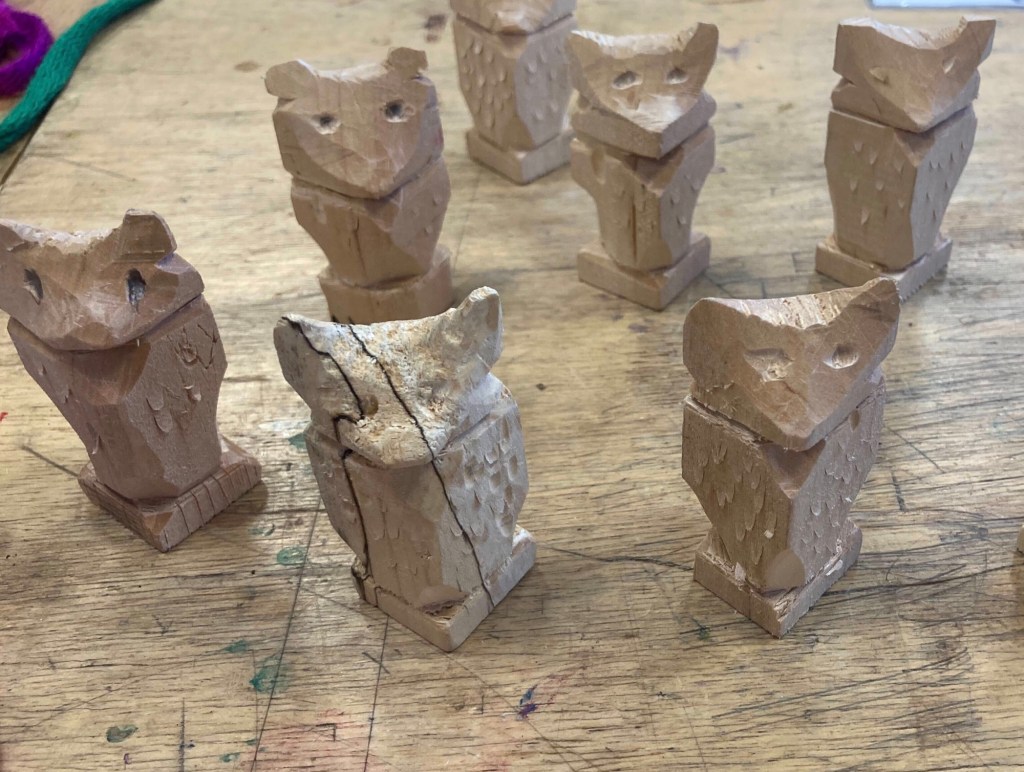
Yesterday I took part in the Maker Space’s Maker Camp. This is our first time offering something like this. The camp started in Monday with 8 youths participating. The first day was Orientation, designing name tags, woodcarving and metal work. I have a few pictures, but I’m only posting those without faces as I have not gotten permission from the parents or teacher to show them.
Some of the owls carved by the young makers in wood working..
Tuesday’s activities were an introduction to stained glass soldering, sewing, and ceramics. My part was showing the students how use a sewing machine. I showed them the different parts and how to wind a bobbin, and thread the machine. I had previously cut 1-yard pieces of different fabrics for them to use for sewing either a pillowcase or a drawstring bag.
Most of the students had no problems. There were two who did not catch on as fast as the others but in spite of a few stitching errors, completed their projects first. Everyone was so proud of their work. I did have one who forgot to sew the bottom of his bag so he put it on like a skirt and walked around wearing it until his group went to their next project. The rest of the week is filled with more ceramics, screen printing, bike maintenance, graphics design, woodworking, and laser cutting.
It was a lot of fun working with those kids and I plan to do it the next time we have an event like this. The camp continues for the rest of the week and ends with the kids learning to screen print after creating a design to go on their shirts. We adults get to have a shirt made as well.
For the next camp, I may suggest adding paper-making and book binding – two things I like to teach. Both are suitable if we decide to host younger kids. Another thing they could do would be would be weaving on a cardboard frame. I have a lot of ideas for the craftier young people.


 Sillytoes Crafts