Category Archives: Crafting

Paper making

I’m teaching a class in basic paper-making on July 20th at the maker space, it’ll be making pulp with the contents of my shredder. I’ve mentioned previously that I’ve done classes like this before.

Once I did a demo for another organization using flowers and herbs embedded in the pulp itself. That was very successful. Papermaking is easy to do, particularly if you have a paper shredder. Turning the shreds into pulp is a great way to prevent identity theft.

Run your shreds through a blender, scoop the pulp up with a specialty frame and press out the excess water with a few weighted objects. Once it dries, random letters may appear, but there’s no way to piece together anything with usable information. I’ve seen tv shows and movies where they painstakingly piece together shredded documents, but the reality is, it would take an incredible number of hours to gain useful information.

I’m not saying it can’t be done, but it’s unlikely for regular people to have their shredded documents pieced back together when there are easier ways of recovering data from computers and phones. But movies and television featuring criminals and spies would be less exciting to watch.

So – now that I’ve wandered off track — I have two sessions planned for paper-making, about a month apart. I have a brand new press to try. I’ve been using a wooden press I acquired many years ago. It’s just two pieces of wood with carriage bolts on the corners that get screwed down. The wet pulp is not particularly good for the bare wood. I also have two bamboo cutting boards that I stack bricks on to use as a press. The bamboo is less prone to the water damage, but still not ideal.

I almost had a 12-ton hydraulic press, but I couldn’t figure out where I would store it at the maker space. It would have been free, but by the time I figured a place for it, it had been sold. It might have been overkill for making paper. It certainly would have flattened it.

So far no one has signed up for the classes. Monday, I’m taking samples and items made from handmade papers to show what can be done. I hope that helps. Otherwise, the classes will be cancelled.

Makers Camp

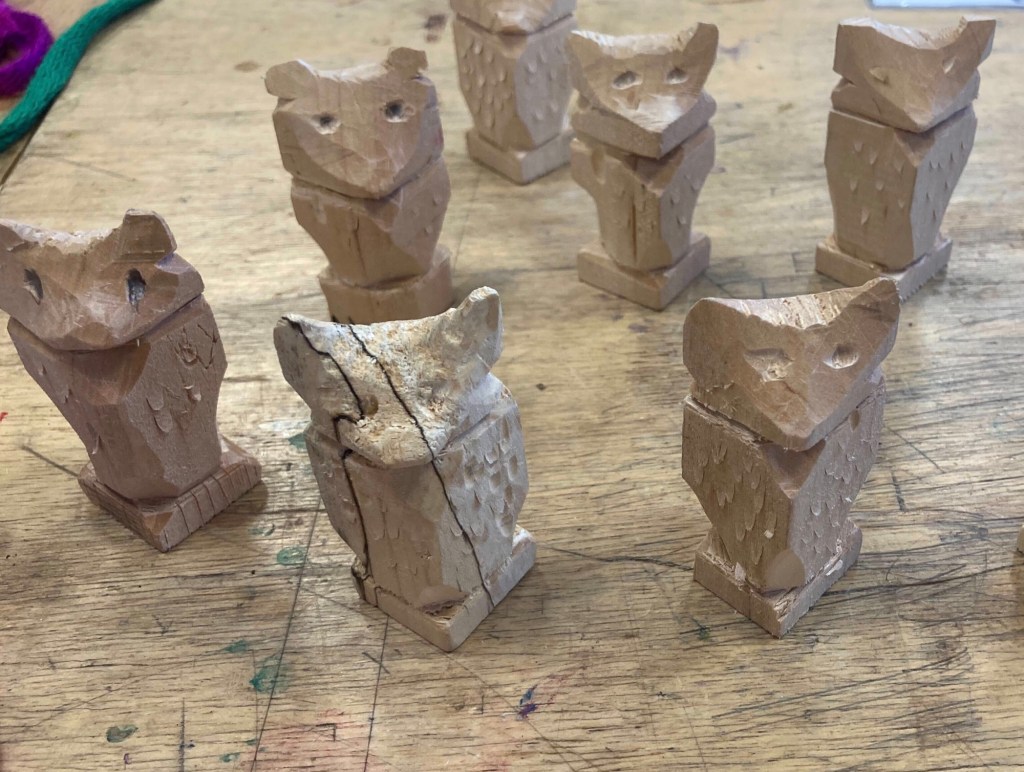
Yesterday I took part in the Maker Space’s Maker Camp. This is our first time offering something like this. The camp started in Monday with 8 youths participating. The first day was Orientation, designing name tags, woodcarving and metal work. I have a few pictures, but I’m only posting those without faces as I have not gotten permission from the parents or teacher to show them.

Some of the owls carved by the young makers in wood working..

Tuesday’s activities were an introduction to stained glass soldering, sewing, and ceramics. My part was showing the students how use a sewing machine. I showed them the different parts and how to wind a bobbin, and thread the machine. I had previously cut 1-yard pieces of different fabrics for them to use for sewing either a pillowcase or a drawstring bag.

Most of the students had no problems. There were two who did not catch on as fast as the others but in spite of a few stitching errors, completed their projects first. Everyone was so proud of their work. I did have one who forgot to sew the bottom of his bag so he put it on like a skirt and walked around wearing it until his group went to their next project. The rest of the week is filled with more ceramics, screen printing, bike maintenance, graphics design, woodworking, and laser cutting.

It was a lot of fun working with those kids and I plan to do it the next time we have an event like this. The camp continues for the rest of the week and ends with the kids learning to screen print after creating a design to go on their shirts. We adults get to have a shirt made as well.

For the next camp, I may suggest adding paper-making and book binding – two things I like to teach. Both are suitable if we decide to host younger kids. Another thing they could do would be would be weaving on a cardboard frame. I have a lot of ideas for the craftier young people.

Summer Camp.

Next Tuesday, the 9th, I will be teaching some young folks how to sew. The maker space I belong to received a grant to buy instructional kits for various shop areas. My area got 6 beginner sewing machines and I’ll be teaching groups of 4 to 6 students the basics of machine sewing.

This is our first year doing this summer camp, so it will be a learning experience for almost everyone. I’ve taught classes before. I did a paper making class for some elementary students and their parents as part of a public library program. I’ve taught simple printmaking, bookbinding, and a sun-catcher class to a group of variously challenged adults as part of an outreach program.

I’ve done basic book making classes for members and the public at the maker space several times as well as helping a troop of Girl Scouts with bookbinding. I have two classes scheduled for beginning paper making. These are paid classes where I provide the tools and supplies. I don’t actually make much money on these classes except to cover the cost of supplies. These particular classes are the first where I’ve offered a two-tier pricing – one for adults and half-price for ages 5 to 17.

For the Summer Camp, I plan to start with a simple pattern to show them the basics of reading a pattern. They won’t get much practical experience with the pattern, but I want to show them basics like seam allowances and markings and fabric grain. I’ll have some kits made up for making either a pillow case or stuff sack. I’m not certain if I will let them use an iron to press the fabric.

I’ll explain the parts of the sewing machine, how to wind a bobbin, and how to thread the machine. I’ll demonstrate each step and let the students try the steps. Next, I’ll explain the guide markings on the throat plate and how to tell if they are sewing straight. I’ll show them how to tell the right/wrong sides of the fabric and how to pin the seams together. I’ll give a demo on starting and ending seams.

They should have an hour to make the pillowcases and stuff bags. I’ll post pictures of the bags. The students might be holding them up, but there won’t be faces showing. I don’t post pictures of kids without parental approval.

 Creating Artist Trading Cards with Dollar Tree Crafter’s Square Items

Way back during the Great Covid Lockdown, I did an online session on making Artist Trading Cards for members of the Bodgery, a maker space here in Madison.

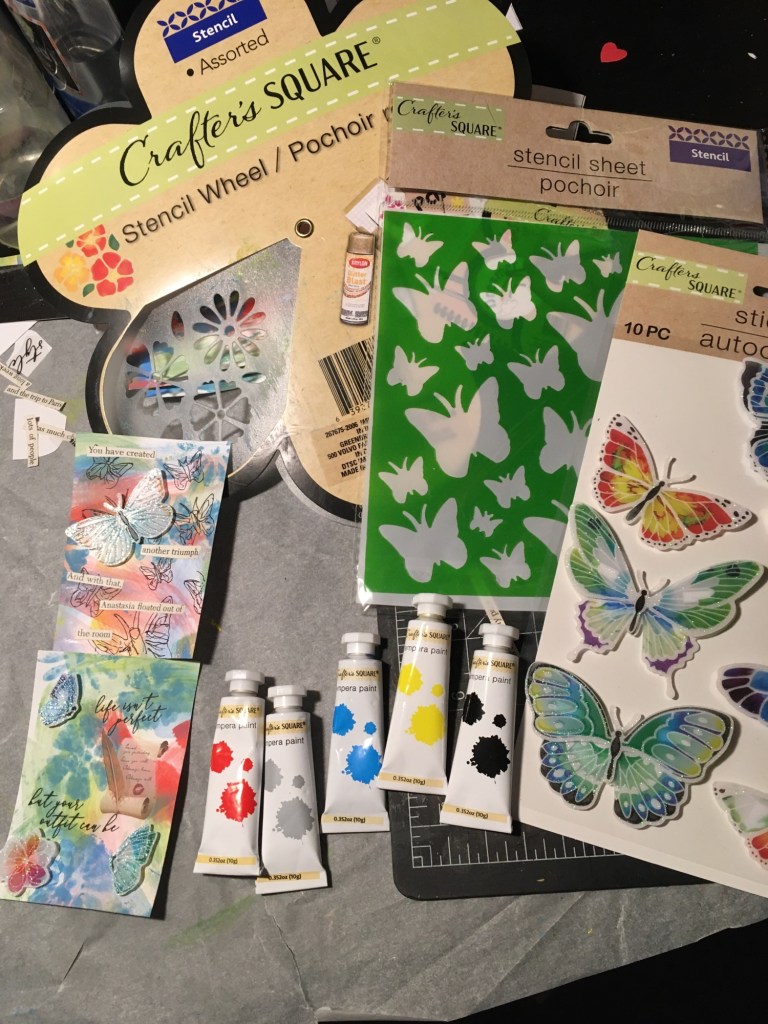
Supplies

From the Dollar Tree

Crafter’s Square:

  • Stencils
  • Stickers
  • Rub-on stickers
  • Tempera Watercolor
  • Rubber stamps

Other supplies

  • Sheet of sturdy paper such as card stock, drawing paper, watercolor paper, or Bristol board sized 8-1/2 by 11 inches.
  • Ruler, craft knife, and cutting mat, or paper trimmer
  • Ink pads
  • Paint brush – about ½ inch (across or in diameter) depending on whether you have a flat or round brush.
  • Scissors
  • Magazine or book pages
  • Glue or glue stick
  • Pencil
  • Fine-tipped black pen
  • Something to use as a palette.
  • Two containers for water
    • One for rinsing brushes
    • One for clean water to dilute paint.
  • Rag or paper towels for wiping brushes.

Optional:

  • Craft heat gun or hair dryer for drying paper.
  • Cosmetic sponge or dauber for distressing edges.
  • Distress ink or tan ink pad for distressing edgesd
  • 12 x 12 single-sided cardstock cut to 7 by 10-1/2 inches.

On the back of the sheet of paper, mark boxes 3-1/2 inches tall by 2-1/2 inch wide. The number of cards will depend on the orientation of your paper. 8-1/2 by 11 will make 9 cards;11 by 8-1/2 will make 8.

Once you mark off the card shapes, turn the paper over. Squeeze a small blob of the three primary colors onto the palette. Dip your brush into the clean water container and then into your first color.

Make random streaks and lines in each color across the paper. Clean brushes after each color to keep them clean. Overlap marks to create additional colors. Let paints dry.

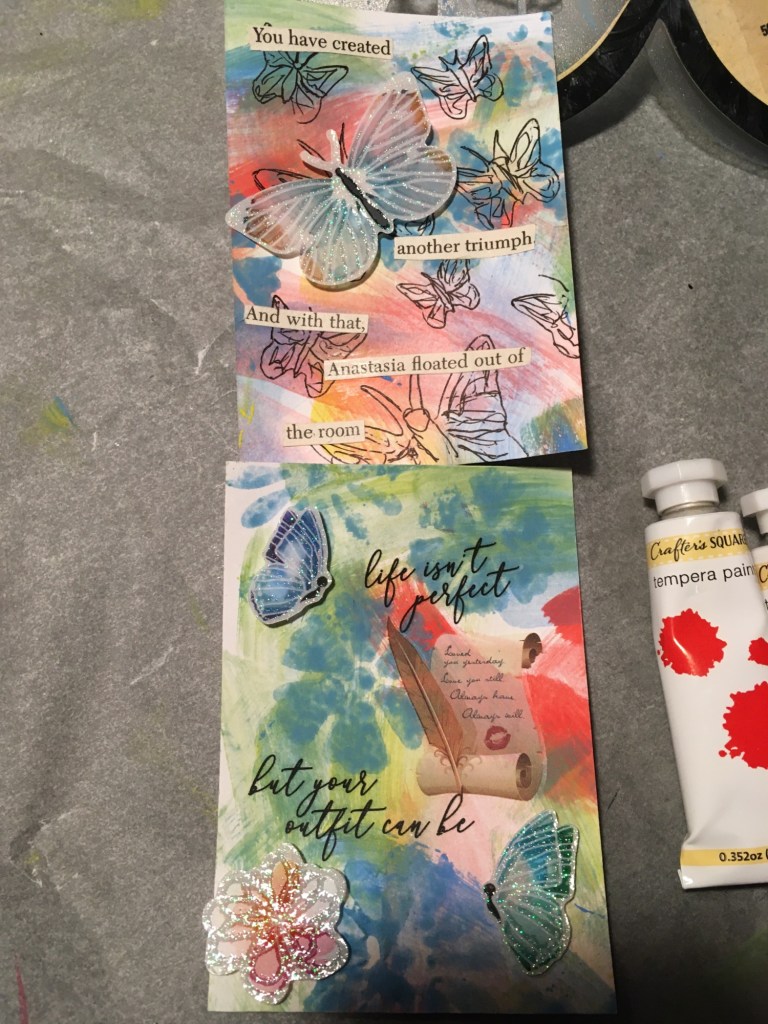
Stamp images randomly across paper to create additional background interest. Cut cards apart and distress edges if desired. Use book pages to select words and phrases to decorate front of cards. Select embellishments from sticker sheet for front of card.

Before gluing items down, test arrangements. Once you are satisfied, glue everything down. To ensure lasting adhesion, apply glue to each sticker and phrase before laying them down. Glue stick adhesive tends to dry out and lift after a while.

Crafter’s Square art supplies.

A couple of finished cards.

The items are fairly nice to use and affordable so any one with a couple of dollars can make a small piece of art to share. You don’t need to spend a lot of money on art supplies.

Since the time I did this class, Dollar Tree has added more craft supplies including fabric and vinyl that can be used with die-cutting machines such as Cricut. If there’s a store near you, check them out.

What the heck is with the long absence?

Total depression- the kind that makes you want to just give up. But I didn’t. I got help, but it took a long time. Things are looking up and I’m getting more involved. I’ve spent too much time not doing anything except hiding between book covers. Books aren’t demanding. They don’t ask to borrow money and not pay you back on payday. They don’t call and then proceed to tell how their life is sucky and not ask how I’m doing. They don’t make you feel unloved and useless. And it’s better to read a book than to try to eat the pain away. Been there, didn’t work. Weighed 200 pounds. Not any more.

I’m holding the line here. I have a long way to go. I’ve started by getting my surroundings in order – getting the house presentable, clearing weeds and invasive plants from what used to be my garden. I’ve got a few tomato and pepper plants in pots. Pots of flowers are on the front steps. I’ve mowed a few times. Everything looks good from the street.

I’ve showered more. I’m certain people who encounter me appreciate that. I’ve been eating more fresh stuff instead of frozen pizza. I wore myself out doing a screen printing project for the makerspace I belong to – 120 aprons and 90 tote bags as gifts for our members. Tough work to do alone in a week, but it was a last minute decision and everyone else works during the day.

After all that, I did a “State of the Union” type presentation to the membership. It went well in spite of a few technical difficulties and interruptions. One of our founders doesn’t quite understand that we know who she is and she doesn’t really need to remind us of the fact whenever she is present by interrupting.

I’ve fallen six times in the last month. No injuries to speak of, but a bit concerning. I’m being sent to the Geriatric Fall Clinic. Apparently, I now fall – see what I did here- into the Geriatric category. I didn’t notice. But now when I look, I can see that some old woman managed to swap bodies with me – gave me this wrinkly and painful one. This old body seems to fall down too much. I want my other one back.

That’s probably all the update you can take for now, so I’ll end here. As a friend used to say, “Rest and be kind.”

Making book cloth using iron-on interfacing

I like to have colorful book covers for my handmade books. I have a supply of library quality book cloth, but it is solid-colored, boring, institutional looking, but it’s very sturdy.  I also have some nice Japanese papers that I use to cover book board as well. But sometimes I want a cloth cover, but not a plain one. I found some videos on YouTube that showed a way to make book cloth from regular fabric. The videos I learned from are listed below.

The supplies you will need are:

  • A Fat quarter from the fabric store or a half yard of fabric

A fat quarter, if you don’t know, is a specific cut from a yard of fabric. It is not the same as a quarter yard. When you order a quarter yard, you get a cut of fabric 9 inches in length across the width of the cloth. A fat quarter comes from a yard of fabric cut lengthwise and widthwise to make 4 equal sized pieces of fabric, 18 by 18 inches for 36-inch-wide fabric or 18 by 22 inches for 45-inch-wide fabric. Fat quarters are readily available in fabric and craft stores and in the sewing section of Walmart and similar stores for under $3.00 US.

  • Lightweight fusible interfacing – the double-sided kind. One side will be fused to the fabric and the other to the next item on the list. The interfacing can be found in the fabric by the yard section of the fabric stores and as a 1-yard pre-packaged cut in the crafts area of other stores.
  • White tissue paper. You want white because the dye used for colored tissue tends to bleed if it gets wet.

You will also need:

  • An ironing board
  • A pressing cloth
  • An Iron
  • A cutting mat
  • A ruler or yard stick
  • A rotary cutter or scissors

Wash and dry your fabric to remove any sizing. I usually wash all my fat quarters at one time, iron them, and fold them once and lay them on a clothes hanger for later. Place your fabric on the ironing board with the wrong side up. Iron out the creases and wrinkles using the steam setting. Cut the interfacing slightly larger than the fabric. Lay the interfacing with the paper liner side up. Turn off the steam setting or empty the iron. Press according to the instructions on the interfacing package. Follow the package directions fir when to peel off the backing paper. Peel the backing paper off and cover with the tissue paper. Iron again to attach the tissue paper. When cool, trim the tissue paper edges flush with the fabric using your rotary cutter or scissors. Roll the book cloth into a tube to avoid creases and store until needed. Use like regular book cloth.


Treasure Books

Nik the Booksmith

Where Have I Been?

In a black hole of depression, that’s where. After “The Road Trip From (To) Hell”, I just kept getting more and more stressed. When that happens, I shut down. To add frosting to the crap cake my life became, my son moved in with me because he quit his job – the tavern he worked at closed its doors a month later – and lost his apartment (included with his job) and wound up, after a bitter battle with his daughter’s mother with whom he had been staying, homeless.

He did find a new job, but his start date kept getting pushed back and of course with no income, he needed to borrow (read – be gifted) money just until he started. He did eventually start his job. He was driving my old car to and from work. He offered $200 for it and then promptly traded it in for a car he can’t afford. His justification was he quit smoking and that the $300 a month he was spending on cigarettes would fund the car payments. Lies.

At least he likes this job. No more cooking. He has benefits! He’s never before had health insurance, and dental insurance, and sick leave, and vacation! Wow! Other than having a Covid scare, he hasn’t missed work or called in hungover. Even better, he’s not living with me.

I thought I was holding it together fairly well, until I totally lost my cool while giving a tour to strangers and potential members of the maker space I belong to. I then decided to take some alone time and not interact with too many people. So far it’s been working. I’m better. I got my sleep re-regulated so I now get longer unbroken hours of sleep. I’m not spending my days dozing on the couch.

Hopefully, I will post more regularly. I’m sorry for having gotten your hopes up last summer when I said I would post more regularly. Thank you for your patience.

When Smoke Gets In Your Eyes…

…and lungs, and hair, and the air filter in the furnace because your using the fan to help circulate air from the window AC. I left the fan on when I went away for three weeks. When I came back the filter was seriously clogged from the wildfire smoke. I changed the filer and three weeks later changed it again. It was not as bad as the first but still worse than when I run the furnace for a month.

It was funny because the filter is rated to up to 90 days. It’s only been 18 days since I changed the filter and its about due to be changed. But you know, climate change isn’t really a thing. Yeah, and my sarcasm knob is turned up as high as it goes and that’s not high enough. I’m just as at fault as everyone else.

I have two ceiling fans going on the main floor and a window fan in the half-story blowing hot air out. The furnace fan pulls cool air from the window AC when it’s on and circulates it from the air returns along with air it pulls in from outside through the ground floor.

I drive too much. I would drive less but not every bus will get me where I need to go even with walking some distance. I do try to consolidate trips and confine them to one area at a time. The city revised the bus system so there are now fewer routes that just circle the city and some of the places I could go by bus within an hours time take almost twice as long because there’s no longer a direct bus.

Well, back to business. There will be more crafting news coming. The problems I’ve been having are just about resolved. I should have more time now. There is still a lot of smoke in the air. Breathing is rough. Eventually, the fires will burn out and the air will clear, until next time.

Faux Leather for journal covers

Only two members showed up for my faux leather session. We were turning paper grocery bags into a leather textured material for journal covers.

There are a number of videos on YouTube and several blog posts about the process. The technique we used consisted of opening a bag’s seam, smoothing it somewhat flat, and trimming it into a rectangle. Then it was sprayed either with plain water or a mixture of water and a softening agent such as glycerin, hair conditioner, or hand lotion. We used hair conditioner mixed one part conditioner to two parts water in a spray bottle.

After spraying the paper, we crumpled it and squeezed it in several different directions to form wrinkles of varying sizes. We smoothed our papers, sprayed the paper with more of the conditioner mixture, and crumpled the paper again. We smoothed and sprayed and crumpled until we were satisfied with the texture.

Our next step was to smooth the paper, and dab diluted acrylic paint in various shades of brown onto the surface with cosmetic sponges and brushes. We used a heat gun to damp dry the paper and apply more paint. Once we were satisfied with how our sheets looked, we used a heat gun to dry the base.

Once the surface was dry, a couple of coats of Mod Podge were applied to give a shine like finished leather to the paper, allowing each coat to dry before applying the next coat.

The faux leather is somewhat fragile and should be lined with something like muslin or even paper. The lining should be glued on with a glue such as Beacon 3-in-1 or Aleene’s Fabric Fusion if using fabric or Aleene’s Tacky Glue if using paper as a lining. I also advise sewing the faux leather and lining together around the edges after trimming the piece to the size you want.

The faux leather can be used as a binding for a journal. It can be cut into shapes for embellishments. And with care, can be used for earrings if a stronger sealant is used on both sides. It won’t be something to be used for items that get a lot of handling or wear, but you can experiment and find out what works.

A sheet of Faux Leather from a grocery bag.
A journal covered in Faux Leather.

I wanted to take it easy today.

However, I was looking for my cash box which I wrongly remembered as being in the basement. When I didn’t find it there, I went up to the closet in the main room of the half-story. Big mistake. It was like finding a pirate’s hoard, except it was just stuff. I have three air mattresses up there. I found boxes and bins of forgotten yarn.

I already have too many bins of yarn under my bed, and in small bins stashed on shelves of one of three bookcases in the living room. Plus there was a big box of yarn upstairs that was not hidden away. Fortunately, I only have to hold on to the yarn upstairs until the next prison yarn drive. There’s a program that teaches inmates to knit and crochet. I’ve donated lots of yarn for three years. I swear it multiplies in the bins.

I found many treasures up there. Handmade dolls and toys including a couple of dolls I made for my son when he was a toddler. There were dolls I made my youngest granddaughter. And all kinds of art projects from both of them that are carefully put away. I found an entire bin of my granddaughter’s art work that she made on our Saturday afternoons together. I plan to bind them into several books – there are a lot of drawings and paintings.

I did not find my cash box which was the entire reason for the treasure hunt. I did get everything put away and a bit better organized. The yarn got moved to the front so I don’t forget it. I searched a different part of the basement, but didn’t find the cash box there either.

So off to the garage again. I had moved the bins that I previously thought were missing. If I had labelled them, they would not have been missing since they were clearly visible as storage containers, but not as craft show containers. I found the cash box.

I’m making a list for what I need for set-up on Friday, double-checking that everything is priced and in the app for the card reader so I don’t have to use a calculator. It took a couple of hours to verify everything and get additional labels made. There are still a few things to do tomorrow like getting the display items gathered, but for the most part, I am done.

I used the weed whacker to clean out cracks in the concrete part of the driveway and started edging the asphalt and prepping for crack filler. I also used critter repellant in my flower pots because the chipmunks and squirrels were digging in them. Then I mowed the backyard and arranged the furniture.

Now I need to set things up to get an idea of how my displays will look and to swap out containers and supports as needed. I have two days.